New Paper on Phenomena-Oriented Validation of Neural-Network Wind Downscaling
Our team has published a new paper in Frontiers in Marine Science on validating neural-network based downscaling of surface wind fields over the Arctic seas.
The article, “On the phenomena-oriented validation of spatial neural-network based surface wind downscaling over the Arctic seas,” was authored by Vadim Rezvov, Mikhail Krinitskiy, Alexander Gavrikov, Vasilisa Koshkina, and Ekaterina Demidova.
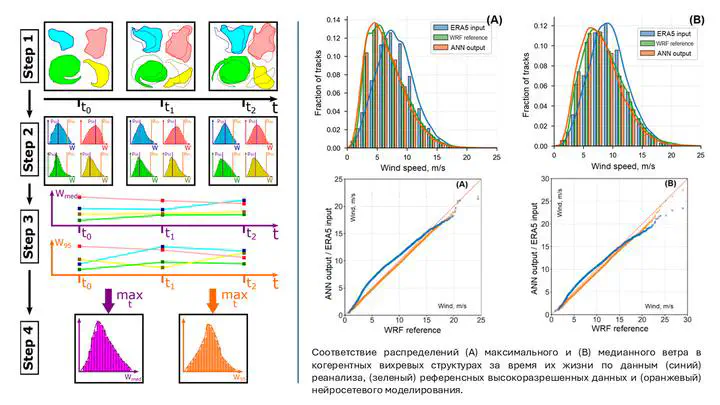
The study addresses a central challenge in statistical downscaling: standard pointwise metrics do not fully show whether reconstructed atmospheric fields are physically realistic. The authors therefore evaluate the downscaled winds through mesoscale phenomena that matter for Arctic marine conditions, including polar mesocyclones and the Novaya Zemlya bora.
The neural-network model is trained to downscale ERA5 reanalysis data using high-resolution WRF simulations as a reference. According to the paper, the model captures mesoscale spatial variability, closely reproduces distributions of vortex intensity characteristics, and produces wind fields that lead to realistic significant wave heights when used as forcing for a wave model. The approach is also much faster than non-hydrostatic modeling, while still requiring a high-resolution reference dataset for training.

Mikhail Krinitskiy
Head of lab
Current research interests are machine learning and deep learning of various flavours applied in Earth Sciences started with observational applications, now shifted to generic data mining and natural processes modeling. The main applications are in Atmospheric sciences, including remote sensing, and also in Ocean sciences. There are also some applications in geochemistry and paleoreconstruction applications. Lecturing masters courses “Machine learning for Earth Sciences” and “Deep learning for Earth Sciences,” a.k.a. ML4ES and DL4ES (Rus.) in Moscow Institute of Physics and Technology and in Lomonosov Moscow State University.