New Paper on Neural-Network Bias Correction for Arctic Weather Forecasts
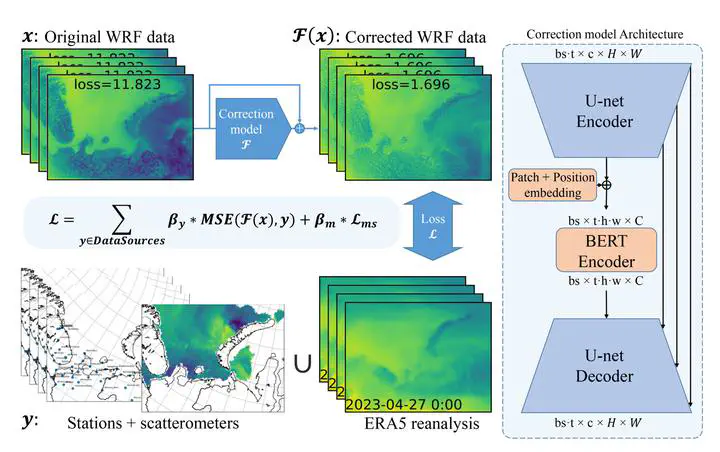
Our team has published a new paper in Quarterly Journal of the Royal Meteorological Society on neural-network bias correction for high-resolution atmospheric forecasts.
The article, “Neural network atmospheric bias correction on heterogeneous data with fine-scale dynamics preservation,” was authored by Viktor Golikov, Mikhail Krinitskiy, Alexander Gavrikov, Evgeny Burnaev, and Vladimir Vanovskiy.
The study focuses on a practical problem in numerical weather prediction: high-resolution regional models can represent mesoscale atmospheric structures, but they also contain systematic errors. Statistical bias correction can reduce these errors, yet simple correction toward coarser or sparse reference data may smooth out the fine-scale dynamics that make high-resolution forecasts useful.
The authors propose a neural-network correction method that improves forecast accuracy while preserving small-scale atmospheric structures. The model combines a U-net architecture with Transformer attention in the latent space and is trained on heterogeneous data sources, including ERA5 reanalysis, meteorological station observations, and scatterometer measurements over the Kara and Barents Seas.
According to the paper, the method reaches accuracy comparable with modern neural-network correction approaches while better preserving mesoscale dynamics in perceptual and spectral metrics. The strongest improvements are observed during the sea-ice season, making the approach relevant for Arctic operational forecasting and related marine and ice applications.
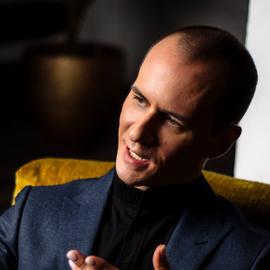
Mikhail Krinitskiy
Head of lab
Current research interests are machine learning and deep learning of various flavours applied in Earth Sciences started with observational applications, now shifted to generic data mining and natural processes modeling. The main applications are in Atmospheric sciences, including remote sensing, and also in Ocean sciences. There are also some applications in geochemistry and paleoreconstruction applications. Lecturing masters courses “Machine learning for Earth Sciences” and “Deep learning for Earth Sciences,” a.k.a. ML4ES and DL4ES (Rus.) in Moscow Institute of Physics and Technology and in Lomonosov Moscow State University.