Arctic climate system and its influences on climate extremes
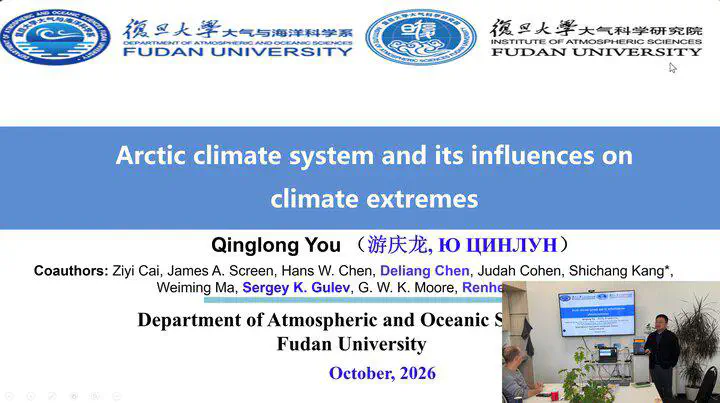
At the 64th seminar of the MIPT Center for Earth Sciences, Qinglong You of the Department of Atmospheric and Oceanic Sciences at Fudan University, China, presented “Arctic climate system and its influences on climate extremes.” The seminar took place on October 8, 2026, from 14:00 to 15:00 Moscow time. Delivered in English, the talk brought together evidence from observations, reanalyses, and climate-model experiments on changes within the Arctic and their possible consequences beyond the region.
The first part of the talk addressed Arctic amplification—the faster warming of the Arctic relative to the global mean. The presented evidence indicated especially strong winter warming and pronounced changes over the Barents and Kara seas, alongside sea-ice loss, increasing precipitation, and more frequent extreme warm episodes in some areas. The speaker related the marked winter signal to a local feedback: reduced ice cover allows more heat to pass from the ocean to the atmosphere, potentially amplifying the warming. Regional differences, however, reflect not only local processes but also atmospheric and oceanic transport of heat and moisture.
Particular attention was given to internal decadal climate variability. The talk discussed how Atlantic Multidecadal Variability (AMV) may modulate northward ocean heat transport, sea-ice melt, evaporation, and Arctic wetting, while the Interdecadal Pacific Oscillation (IPO) may affect atmospheric circulation and a spatial sea-ice dipole between the Atlantic and Pacific sectors of the Arctic. The dipole was identified in observational data and reproduced in the model experiments presented. These results were framed as evidence for the proposed mechanism, not as a definitive test across all models: the discussion noted the limited set of available ensembles and the need for further evaluation.
Model projections of Arctic warming and wetting retain substantial spread, particularly in regions where sea ice is changing rapidly. The speaker presented approaches that relate intermodel differences to observed features of the contemporary climate system in order to narrow the range of projections. Large ensembles were also used to separate responses to external forcing from internal variability. This separation matters for prediction on decadal timescales: phases of AMV and IPO may temporarily strengthen or weaken regional trends without negating the long-term warming trend associated with external forcing.
The final part considered possible links between the Arctic and midlatitude extremes. Hypothesized pathways involving sea-ice loss, Arctic amplification, the westerlies, atmospheric blocking, and the stratospheric polar vortex were reviewed. The speaker stressed that the response may be nonlinear and dependent on the background state of the ocean and atmosphere, leaving a simple causal interpretation unresolved.
The discussion of major Siberian wildfires focused on the combination of high temperature, precipitation deficits, atmospheric aridity, reduced soil moisture, and land–atmosphere coupling. The presented analysis supported a role for hot, dry conditions and soil-moisture feedbacks in increasing fire-conducive conditions. However, when the audience asked about the connection to the Arctic, no direct physical chain from Arctic change to the Siberian fires was established. Attribution suggestions raised in the discussion should therefore not be treated as settled quantitative estimates: the relationship among Arctic change, midlatitude circulation, and particular wildfire events remains an open research question.