Alexander Lekhnovich: From Cape Schmidt to Observations of Freshwater in the Chukchi Sea
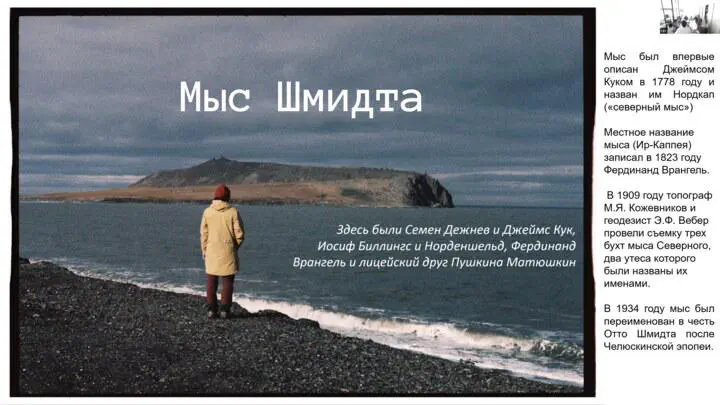 Talk slide about Cape Schmidt
At the 64th seminar of the MIPT Center for Earth Sciences, Alexander Lekhnovich, a member of the Laboratory of Arctic Oceanology, presented a report on the expedition to Cape Schmidt in Chukotka. The seminar took place on October 8, 2026, from 12:20 to 13:40 Moscow time (09:20–10:40 UTC). The talk had no official title; the headline of this page is editorial.
The scientific motivation for the expedition was to investigate the spread of fresher water through Long Strait into the Chukchi Sea and its subsequent transport by the Siberian Coastal Current. The team prepared autonomous temperature and salinity sensors on anchored stations. This approach is intended to provide observations extending beyond a brief visit at sea and across the winter period—once the instruments have been found, recovered, and their records downloaded.
Organizing the fieldwork became a substantial task in its own right. Infrequent transport, difficult coastal access, and the need for permits prevented the initial plans to join a research cruise. The expedition was therefore carried out from shore with support from a local meteorologist and residents of the Cape Schmidt area. The team deployed one station from a local boat. Participants aboard a passing research vessel helped with the second: they took the equipment aboard and deployed it at the more distant site.
Two stations were deployed in total. During the coastal work, the expedition team also profiled the water column. According to the preliminary data presented, salinity in the area of the Siberian Coastal Current was about 27–28 PSU, with freshening extending to approximately 22 m. The speaker associated this structure with possible west-to-east transport through Long Strait and discussed a potential contribution from the preceding westerly wind. This remains an interpretation of initial field profiles, not a recovered time series or a completed analysis.
Questions after the talk focused primarily on whether the stations would survive the ice season and how they could be recovered. The team plans to return for the instruments during the next field season, either from a research vessel or, in suitable weather, from a local boat. After recovery, they intend to download the year-round record, assess its quality, and—if conditions and permits allow—redeploy the equipment. The principal result of this stage is therefore the successful start of long-term observations and a field-tested model for coastal work, rather than an already available year-long data set.