Who Will Do Science in the Era of Advanced AI—and How? Research Automation, AI in the Physical World, and the Role of Humans.
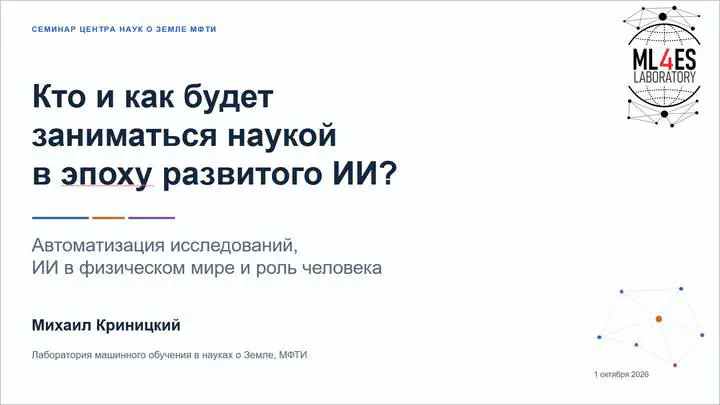
At the 63rd seminar of the MIPT Center for Earth Sciences, Mikhail Krinitskiy, head of the MIPT Laboratory of Machine Learning in Earth Sciences, invited the audience to consider who will do science as artificial intelligence develops—and how. The talk was deliberately framed around questions rather than settled predictions: how far research automation can go, how the scientist’s role will change, and what responsibility will remain with humans.
According to the speaker, large language models combined with agentic tooling already handle both individual operations and longer sequences of work: literature and text processing, writing and testing code, analyzing data, planning hypothesis tests, and iterating on results. Tasks whose outcomes can be formalized and checked computationally—such as programming, mathematical proofs, or numerical experiments—are especially amenable to rapid automation. Collecting data and testing hypotheses in the physical world remain a more difficult boundary. Yet examples of robotic laboratories, autonomous observing systems, and embodied AI suggest, in Mikhail’s view, that this boundary is not fixed either.
This automation is already changing researchers’ everyday roles. An experienced scientist may spend less time writing code by hand, focus more on framing tasks and evaluating results, and oversee several lines of research at once. Acceleration is not guaranteed, however: additional alternatives require validation, and the route to a dependable result can sometimes become longer. The talk therefore separated at least three questions: whether the profession of scientist will disappear, whether the functions performed by people will change, and whether fewer people will work in science. None has a clear answer yet.
The central problem was the reproduction of scientific expertise. Beginners learn not only from books and finished answers but by making their own mistakes, diagnosing their causes, and developing critical judgment, physical intuition, and the ability to validate conclusions. If automated systems bypass that path entirely, a result may be obtained without an understanding of how it arose. Mikhail did not advocate simply banning AI for students. Instead, the discussion pointed to the need to structure its use so that the tool supports learning without removing the manageable intellectual obstacles through which expertise develops.
Another part of the conversation concerned scientific reputation and resource allocation. A paper communicates knowledge, but it also signals the competence of an author or a team to colleagues and funding bodies. The more stages of research are automated, the more ambiguous that signal becomes. Search and recommendation systems already redistribute attention among publications, while AI contributes to the preparation of manuscripts and proposals; access to these tools is also uneven. The participants discussed how, under these conditions, to evaluate a researcher’s contribution, decide whom to trust with expert judgment and funding, and determine who can independently check a result.
Mikhail concluded by returning to the boundary of human responsibility. For now, framing the central question, choosing meaningful data and criteria, judging physical plausibility, and understanding the route to a result remain with the researcher, but he cautioned against assuming that this boundary is fundamental or permanent. In the discussion of authorship, he stressed that there is no final answer and offered a practical principle: a person who puts their name on a study must understand it and take responsibility for its results. The seminar therefore ended with an open question: what role will remain for humans if automation continues to expand across the research cycle, and how can we preserve the human capacity to ask questions, check answers, and be accountable for them?
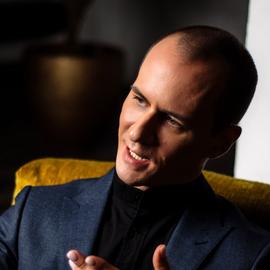
Mikhail Krinitskiy
Head of lab
Current research interests are machine learning and deep learning of various flavours applied in Earth Sciences started with observational applications, now shifted to generic data mining and natural processes modeling. The main applications are in Atmospheric sciences, including remote sensing, and also in Ocean sciences. There are also some applications in geochemistry and paleoreconstruction applications. Lecturing masters courses “Machine learning for Earth Sciences” and “Deep learning for Earth Sciences,” a.k.a. ML4ES and DL4ES (Rus.) in Moscow Institute of Physics and Technology and in Lomonosov Moscow State University.