Vasilisa Koshkina: Automatic Identification, Tracking, and Diagnostics of Mesoscale Atmospheric Vortices
Vasilisa Koshkina’s talk focused on automatic analysis of mesoscale atmospheric vortices in numerical-model data. The seminar began with the physical context of these objects: a broad family of mesoscale vortex processes that includes polar lows, tropical cyclones, and smaller vortices that are harder to classify formally. The speaker showed how cyclonic and anticyclonic structures can be detected from wind fields and vortex criteria, and how their geometry, center position, and physical characteristics can be estimated.
The second part of the seminar addressed tracking: connecting vortices identified at individual time steps into consistent trajectories. Vasilisa described the tracking methodology under development and its validation for the North Atlantic and Arctic regions. The discussion covered comparison with manual expert labeling, reproduction of tropical cyclone tracks using HURDAT-2 and best track data, and comparison with existing polar-low databases. Participants paid particular attention to ambiguous cases involving merging, splitting, and regeneration, where the physical interpretation of a trajectory may depend strongly on the chosen tracking criterion.
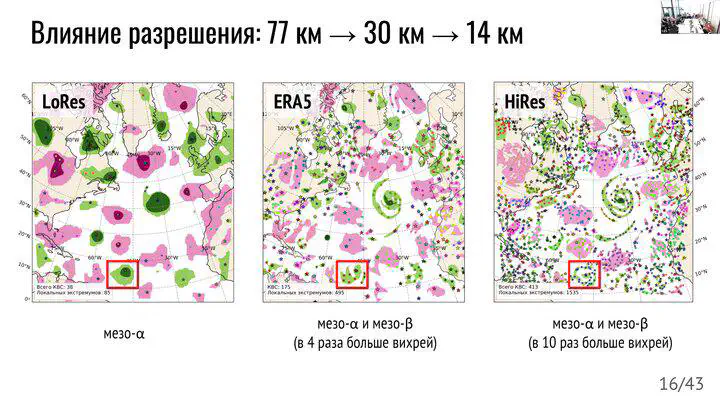
The final part of the talk discussed plans for classifying vortices using thermodynamic, geometric, and climatological descriptors. The speaker outlined feature selection, parameter correlations, normalization, dimensionality reduction, and clustering, including preliminary k-means results. The seminar concluded with a discussion of clustering robustness, the effect of spatial resolution on the representation of mesoscale processes, and possible thesis statements. These results are expected to support a future climatology of different types of mesoscale vortices over the North Atlantic and Arctic.