Matvey Novikov: Modeling the Influence of Biochemical Processes on Redox Conditions in the Black Sea
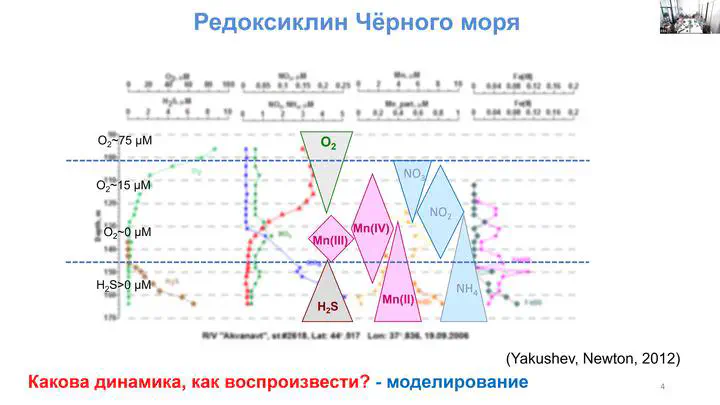
Matvey Novikov’s talk was a rehearsal of his PhD pre-defense presentation on modeling the influence of biochemical processes on redox conditions in the Black Sea. The seminar began with the specific setting of the Black Sea as the largest basin with a stable hydrogen-sulfide zone: oxygen is present only in the upper part of the water column, while the transition between oxic and reducing conditions occurs within a thin redox layer. This layer, its structure, and its variability were the central focus of the study.
Matvey presented the dissertation framework and its main tasks: improving models of biochemical processes based on current understanding of redox conditions, estimating the oxygen balance in the redox layer with a one-dimensional model, analyzing hydrochemical changes over recent decades, and using a three-dimensional model to assess bottom hypoxia formation in coastal areas. The work used observational data from the Shirshov Institute of Oceanology, published datasets, reanalysis products, and numerical experiments.
The first technical part of the talk addressed one-dimensional modeling of the deep-water Black Sea. The model included vertical turbulent exchange, settling of suspended matter, and biogeochemical reactions. Particular attention was given to a parameterization that links dissolved manganese settling to suspended matter. This improvement helped reproduce the vertical distribution of dissolved manganese and estimate the contribution of different processes to oxygen consumption: within the redox layer, the manganese cycle plays an important role alongside organic-matter oxidation.
The next part focused on hydrochemical variability from 1995 to 2024. The speaker showed how the positions of oxygen and hydrogen-sulfide boundaries are connected to density structure, the cold intermediate layer, salinity, temperature, and ventilation after cold winters. The discussion highlighted that warming and reduced oxygen solubility may decrease the volume of oxygenated water, while individual cold winters can temporarily strengthen ventilation and shift the redox boundaries.
The final part of the presentation discussed applied three-dimensional modeling of bottom hypoxia in the Varna Bay, Lake Varna, and Lake Beloslav system. The model scenarios considered river runoff, inputs from wastewater treatment facilities, their combined effect, and increased nutrient loading. The results showed that even moderate inputs of nutrients and organic matter, when combined with seasonal stratification, can cause oxygen depletion near the bottom, while the location of hypoxic zones changes under the influence of currents and wind.
After the talk, participants discussed thesis-statement wording, reliability of observational datasets, limitations of one-dimensional and three-dimensional model setups, the role of manganese, interpretation of trends, and which results should be emphasized at the pre-defense. The discussion was practical in focus: how to present a large modeling study compactly, which conclusions should be central, and how to connect technical model improvements to physically meaningful results.