Dmitriy Sein: Regionally Coupled Ocean-Atmosphere Modelling
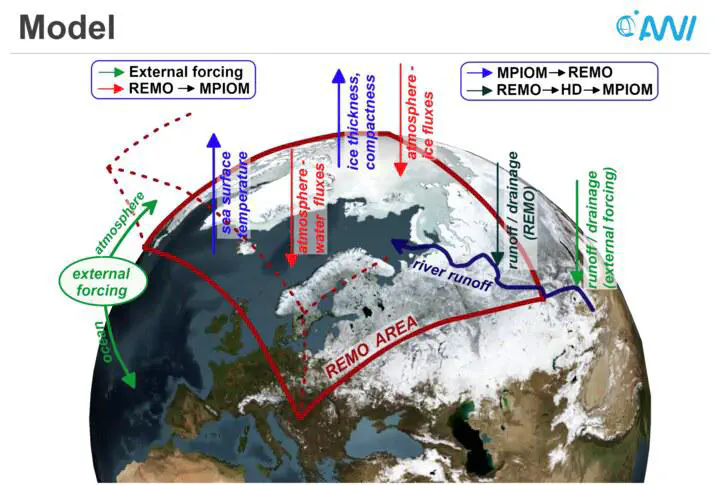
Dmitriy Sein’s talk focused on regionally coupled ocean-atmosphere modelling, an approach in which the ocean and atmospheric components are considered together while the resolution and target domain can be adapted to a specific scientific problem. He began with the history of such configurations: when convenient ocean boundary conditions were not available, a global ocean was used with local grid refinement in regions of interest, for example in the Arctic, and a regional atmosphere was placed above it.
One of the central themes of the seminar was the choice of a regional-model configuration. Dmitriy Sein emphasized that regional modelling is not simply a matter of choosing an interesting area: the location and size of the domain, boundary conditions, the representation of ocean and atmosphere, and the set of tuning parameters can all substantially change the result. A key practical point emerged in the discussion: a model should not be tuned only to temperature, wind, or pressure without checking what happens to precipitation, convection, and other related processes.
A separate part of the talk addressed the role of the ocean in climate simulations. Participants discussed ocean heat transport, Arctic circulation, freshwater anomalies, deep convection, and the connection between ocean processes and large-scale climate. The examples showed why including ocean tides and a more realistic position of currents can affect the Gulf Stream, precipitation patterns, and the quality of climate experiments.
The seminar also discussed the distinction between weather forecasts, decadal predictions, and climate projections. Atmospheric forecasts are constrained by initial conditions and have a short horizon; decadal predictions depend more strongly on the initial state of the ocean; climate projections consider longer timescales and scenario-driven changes. Against this background, the discussion touched on data assimilation, attempts to bring the ocean state to a prediction start date, and cases where such procedures can degrade precipitation fields.
In the final part of the talk, Dmitriy Sein showed examples of high-resolution ocean simulations: global and regional configurations with kilometre-scale resolution, strait dynamics, internal waves, tidal processes, the Sea of Okhotsk, and other regions. These visualizations illustrated how high resolution reveals processes that cannot be represented properly in coarse models, and why coupled ocean-atmosphere modelling remains an important tool for studying climate and extreme weather events.