Alexander Lekhnovich: The Ob and Yenisei Plume under the Laptev Sea Ice
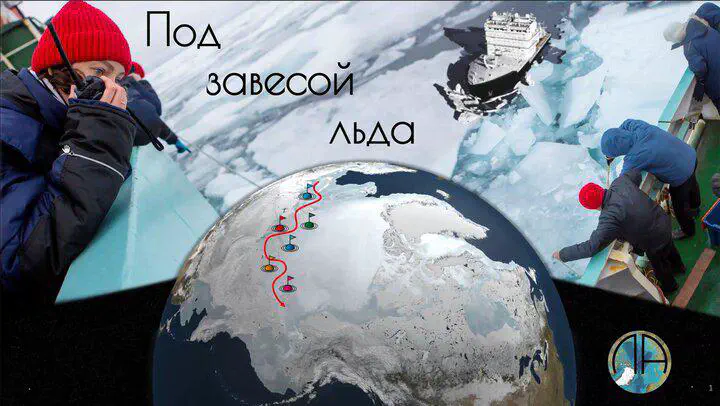
Alexander Lekhnovich’s talk focused on winter-spring thermohaline variability on the Laptev Sea shelf and on the role of the Ob and Yenisei plume entering from the Kara Sea under the ice cover. The work grew out of an analysis of automatic bottom-station records, which measured temperature and salinity for several years in different parts of the Laptev Sea, combined with expedition data and ice charts.
The seminar began with the seasonal cycle on the shelf. In summer, near-bottom changes are relatively gradual, whereas winter and spring contain sharp events: autumn warming and freshening, followed by in-phase cooling and freshening in mid-winter. This second event became the central focus of the interpretation: it appears annually in the station records, but it is not always consistent with a simple explanation based only on the Lena plume or local wind-driven mixing.
The key hypothesis was that cold and relatively fresh waters from the Ob and Yenisei plume pass through Vilkitsky Strait and spread under the ice into the Laptev Sea. As the plume travels, it cools, becomes saltier, approaches the freezing temperature, and may form an intermediate layer between the Lena plume and underlying marine waters. This structure weakens stratification and can make full-depth mixing over the shelf more efficient.
A separate part of the seminar addressed polynyas and brine convection. During intense ice formation, salt remains in the water, the surface layer becomes denser, and cold saline waters can penetrate downward. Alexander Lekhnovich showed that the timing of full-depth mixing at different stations is difficult to explain by wind or ice drift alone: at some stations, mixing appears earlier where contact with the atmosphere is limited, and later where polynyas are more frequent. This supports the idea that advection of the Ob-Yenisei plume prepares the stratification for subsequent mixing.
The discussion examined how strongly the observations point specifically to the Ob and Yenisei plume. The arguments included the annual arrival of cold and fresh waters in winter and spring, west-to-east propagation of the signal from the Vilkitsky Strait region, and consistency with previous studies of freshwater transport from the Kara Sea. Alternative explanations were also discussed, including local cascading, intermediate layers, and vertical mixing.
In the final part, Alexander Lekhnovich summarized several scenarios for the annual cycle of thermohaline properties: weak or strong initial stratification, the influence of the Lena plume, polynya and brine effects, the arrival of the Ob-Yenisei plume, and isolated years that may involve warmer saline waters. These processes are important not only for regional Laptev Sea oceanography, but also for understanding pathways of river water into the Central Arctic and the possible influence of near-bottom heat on subsea permafrost stability.